
Interview with Riham Ellaw, Executive Board Member and Business Development Director at Nassar Group
For Riham Ellaw, Executive Board Member and Business Development Director at Egypt’s Nassar Group, the path to modernising a traditional family business was never going to be easy. As the first woman in her family to step into the male-dominated steel industry, she faced scepticism from founders who believed transparency threatened their control, employees who feared change, and even family members reluctant to embrace new ways of working. Yet her determination to blend respect for tradition with the urgency of innovation has become the driving force behind the business’s evolution.
In this episode, Riham shares her journey of navigating digital transformation and governance reform. From implementing ERP systems to restructuring authority and redefining leadership, she reveals the emotional battles, strategic compromises, and bold vision that are guiding Nassar Group into a new era. Her story is a testament to the power of persistence, the importance of clarity, and the necessity of preparing a family business for the future – even when the road is anything but smooth.
Key Takeaways:
- Digital Transformation as a Necessity, Not a Choice: Riham faced resistance from founders who believed digital systems would expose the business to risk. By demonstrating how ERP systems could improve efficiency and secure customer loyalty, she shifted the conversation from fear to opportunity, proving that technology is about empowering, not replacing, people.
- Clarity Over Chaos: The lack of defined roles and authority created operational chaos. Riham used the ERP implementation to enforce accountability, mapping out workflows and responsibilities that challenged long-standing power dynamics and brought structure to the business.
- Governance Beyond the Family: Emotional attachments to employees and resistance to external leadership created friction. Riham’s solution was to advocate for separating ownership from management, introducing the idea of external board members and CEOs to reduce family conflicts and ensure the business’s long-term sustainability.
- Leadership for the Next Generation: Riham envisions a future where the second generation acts as board members rather than daily operators, focusing on strategy over operations. Her approach underscores the need for adaptability, professional governance, and a willingness to let go of the past to secure the future.
Transcript:
Ramia: Welcome everyone to another episode of Women and Family Business. I’m extremely happy to welcome my guest today, Riham Ellaw, who is here from the Nassar Group in Egypt. Welcome. So, Riham, we are gonna be talking about like, really interesting topics today, topics that really excite me because I think they’re foremost on the mind of any leader today who’s trying to ready their business for the future. And the two topics that we’re gonna tackle today are digital transformation and governance. Two things that obviously cannot live without each other, but often, you know, have to, um, have to leverage each other into existence. I think what’s really interesting here is that we don’t just talk about digital transformation and governance in any kind of enterprise. We’re talking about it in the context of a family enterprise.
And so, you have gone through these many stages and this kind of transformation with your family business and are here to tell us a little bit more about this experience. And I think the first thing I wanna ask you is how that first conversation goes. When, when you guys realized there, there was a need for digital transformation, there was a need to do things differently, what kind of conversations did you initially have with people in the Nassar Group? Like, you know, what was that like? What was the reception? Uh, did you face a lot of resistance and if so, what kind?
Riham: Actually we didn’t realize that we needed digital transformation. In a specific point, I actually the only one who realized that we have this problem. Okay. Because, um, in family businesses, they’re always, the founders believe that it’s better that they are involved a hundred percent in the business, and it’s better that they know every single.
So as long as they know the details, okay, they believe that everything is just good and working good. Okay. But the problem is for me, after been working in the business for like 8 years now, I’m, I have been the business for 11 years. Okay? I, I knew that we have a problem. There is a problem because most, most of the decisions actually with the founders, no one has authority.
There’s no delegation. And everyone believes that this is the best way to work, but no one is looking at the future. So when I started discussing the idea of digital transformation, the first resistance, actually this didn’t come from the employees, it came from the, it came from the founders and the owner.
Okay. Because they believed that digital transformation will lead to transparency, and they believe that. Being transparent in such business, especially traditional business because Nassar Group, it is, uh, in the steel industry. So they believe that digital transformation will not work in such traditional business, and it is a very, very competitive business.
So if everything is transparent, it’ll be a problem. Okay. For example, at the beginning, they actually had a system before and they actually, they were hiding the name of the vendors. And the customers. Okay. They’re just making it in codes and they’re the only ones who have the documents that shows which code is for which customer and specific people only in the business. Okay. Who knew which, uh, which code is which customer, but like, uh, the finance department, they didn’t know. They, they didn’t know which customer is that. It just codes. Okay. The only one people who knew are the buyers, uh, uh, and our sellers. Okay. They’re the only ones that Department of for Changing and Sales, so. I, I knew that to talk about digital transformation in the future, which we are in now. I knew that at the beginning. I actually has need to build the name of the company. Need, need to build a brand to gain the all the loyalty of the customers. So if anyone knew the information of this customer and they left the business and they did their own private business, they will not be able to steal my customers, because already my customers, they don’t just take a product, they’re actually taking a brand.
Okay? And so it took time to gain the loyalty of the customer and to build the brand of Nassar Group to not feel the idea of people leaving the business. Okay, so after we reached this point, okay. That we have already the brand. Okay. I talked about digital transformation, so I found resistance everywhere.
Okay? Especially that people were scared that they will be replaced. I actually have a conversation with a manager who told me that you need all the information to be in the system. To just tell me in the end, okay, thank you. Bye-bye. I don’t need you. And this is not how it works. ERP doesn’t replace people.
ERP actually help people to work better and to work more efficient. So it took a long time to convince employees, but it also was very hard with the founders because they believe that this will not work in, in such a traditional business. That’s mainly for production. It’s, it’s after all it’s manufacturing. It’s not a services business. It’s not marketing business, so it’ll be easily to put everything in an ERP system. So it took many time to convince them that I told them in the end. Even though you are understand the business very, very well, because you are the one who build it from brick by brick, okay?
Even though you are, you are the best. The second generation will not be able to work this way. The second generation don’t have the experience to feel the business or the experience to feel the market. They are actually data driven. They need, they only understand numbers. Either we are, either we are, we are losing or we are gaining.
Either there is profits or, or there is not even just numbers. They are not like you. So when they reach this point, when, when I told them that this is the only way for the business to continue, okay? So they, they started to accept it even though they believe that it’ll fail. And we are now in the process.
Okay. Even though they believe that it will fail, but they know that this is the only direction that we have to go. So let’s try it. Okay. So when I started the ERP system, and this was very, very challenging, that many people told me, you don’t, before you get an ERP system. I, I actually, I stay, I, I had a meeting with a lot of mentors and consultants and all of that.
They told me that before you get a system, you need to build the business first. You, you need to work on organization restructuring. You need to work on the change management. Before you get the ERP system, you need to have the perfect workflow. You need to have all the system working in its best way.
Then get the ERP system. I tried that for a year. Okay. I tried, I, I got, I said, okay, let’s try. Okay. So I tried with all, all the departments, let’s, let’s build first the department as the book says. Okay. The manual.
Ramia: So like the manual you were working on the first with the manual processes you were trying to
Riham: I found also people say, no, this is how it works. This is how we always work. You just want to make steps to delay the business. For for example, if at the very, very beginning it was very, very silly that actually the imports and the exports manager is the one who’s dealing with the banks and not the finance department. He is the one who’s dealing with the banks. He’s the one who can see all our accounts. He’s the one who’s doing everything because this is the best way and the fastest way. Of course, this is the fastest way. You are the one who’s who, who, who, who is actually doing the purchasing process. So it’s, of course, it’s easier for you that you are the one who’s controlling the money, of course. So it took a lot of time to just separate this work, okay? You are not the one who’s doing this work. You should say that you want to purchase this item. Okay? So the, the finance department is the one who’s gonna work and take the process, and there was a huge resistance in that you are just delaying the process. We need everything as soon as possible.
This is also a huge problem in traditional industries, that everything is so urgent. Everything is so urgent, so it’s so hard to build a workflow, so I reach a point that, okay, this road will be a failure, so I have to get a system. I have to work on digital transformation and get an ERP system to force people to work within the right workflow. Here is the system. Okay? It says that to, to purchase anything, you have to go through this and this and this and that, and that and that. And the authority must be that and that and that and that. So they were forced to work this way. So this is how it worked for, for us. This is how it read, to force people.
Ramia: The ideal case is you have the culture that changes and then you introduce the technology and stuff like that. And so here in this scenario, you have to use the technology to change the culture. And that’s, it’s quite interesting because I think sometimes that is probably the only way if you want to get it done, um. What was the reaction between the generation? So the founders obviously had their opinion about what this was gonna do or not do, et cetera, and in the second generation, how many members do you have of the family?
Riham: Six from the second generation.
Ramia: So the six of you, are trying to sort of like do like, have better information, understand the business better through, through this process. So it’s really interesting because there’s so many systems changes. There’s a change from like a founder’s led business to a second generation business, right? Like from siblings to cousins. And then there’s the change from manual to to digital. Um, in the middle of all that, what were the tools and the things that helped you most to push things forward? Because that, that’s obviously like. Asking so many changes at the same time must have been hugely demanding on both the family and the employees. So how did you, how did you navigate that on a cultural and a communications level? What kind of conversations did you encourage to make sure that as many people stayed on board as possible and as many people, you could take along as many people as possible on this journey?
Riham: The, the main problems that they faced. And the main conversations that I have been taking with the board is that there are, are people in the business who are not qualified enough for the next step. This was the main problem and this what led to change management. Like for example, I need to build a finance department for a specific company. Okay. This company has been always working with, uh, uh, an accountant who, one of the board members believes that he’s very, very good and very, very qualified. Okay. So, okay, I’m gonna give him a chance. This is what I need. And that, and that, and that to build an ERP system in this company.
Okay. And I always believe that, and this, this a huge problem with a lot of companies, that they believe that the ERP system is an IT project. And it’s not like that actually, it’s a project for the whole company, so all the managers must be involved. So the project managers, I believe in my point of view that the project managers should be the finance manager, the CFOs, because they are the ones who can understand the business all over it, and they’re the ones who knows how to, how should the workflow goes right. Okay. So I believe that the CFOs are the ones who should be managing each company in this project. Okay. So I believe that this person is not qualified enough. I tried many times with him. I actually tried a, a whole year with him, okay. Training and trying and trying and trying with him that this how things should work. And he was who was, who was actually very, very resistant. And very, very slow. And he’s showing the board member that, uh, me as Riham doesn’t, uh, doesn’t listen to them. That’s all. She doesn’t listen. She wants things to, to work this way. So she doesn’t believe that we are qualified enough. So the problem is with Riham, it’s not with us. So I suddenly having a fight with my sister, she’s the other board member. So we’re facing a problem with emotional attachment with the employees. You are just want this person to stay in this place because you just like him.
You are more comfortable with him. You are, you trust him. That’s all. He’s not qualified, but because you just trust him. So this was a huge fight and I faced this problem every day with either a cousin or a sister because I’m telling them this one is not qualified and the fight is always no he’s qualified, I trust him. So for me to solve this problem. As I told you, I got the ERP system. I paid all of it in advance. Okay? So I’m just like forcing the founders that, okay, we paid everything. So either it’ll work or will not work. I believe that this person is not qualified enough, so what shall we do? So it was, for me, it was like a weapon. Okay? Each time I find a struggle, I tell, okay, we paid all the money. You wanna throw it? You wanna throw it, or let’s try to deal with it. So, yeah, exactly, exactly. So we reached a point, okay, keep this person as, as he is, because the this board member, trust him and let’s get a new CFO.
And this one will be a chief accountant. Okay? So we didn’t move him from his place. And you got the CFO you want. And let’s, let’s do it. So this is how it works with me. I started building a new executive boards of people who are qualified enough to help me through this system because I know that the current ones will not be able to, they are very, very good in in operation.
They’re very, very good in the daily work, but they’re not good in development. So the board members and also the founder, they need to understand this, that people that we trust, that people who have been with us many, many years, they are going to be very good at a specific step. You will not be able to take them for the other step. It’s impossible. So as soon as they believe that I started, uh, to get new, uh, new managers.
Ramia: It’s interesting how the tech still depends on the human capital factor, doesn’t it? It’s funny how like, you know, we can have all the technology in the world when the, when the human element is not right in the organisation we still can’t make it work. So it’s, it’s always, it’s always interesting to see that reality.
Riham: So you need to have qualified people to be able to, to put the data correctly and to be able to help you. Okay? Because we have a lot of, you have a lot of, a lot of that. You have a lot of data. You can just put it anywhere, anywhere, and you will see a lot of numbers that you just don’t understand. So you need the right people to put the data in the right, in its right place to be able to analyze it correctly. So not everyone understand this issue.
Ramia: When I hear your story and you tell it and the kinds of conversations you have and the kinds of fears that people showed you, right? Like sort of like becoming irrelevant or, and in most cases. Becoming less powerful, I guess, like they felt like control and power was taken away from them. And you and I when we talked about this first, I think we both agreed on how much this kind of process reveals about the governance that’s in place and the governance that’s needed in an enterprise because, uh, obviously that, that kind of comes hand in hand, the decision making structure directly speaks to whether a system like that can work or not, or whether people can concentrate power in an organization to the point where they’re the only ones who know what’s happening and the rest has no idea, right? Like so for you, the governance conversation and the thinking about governance, when did that start becoming a focus area for you as well? And how did it come in connection with the digital transformation?
Riham: There are two types of governance for me, I believe like the governance for the company itself. So to reach the strategy of the company and the family governance. So I was doing both. So for me at the beginning, the governance for the company itself, I found a huge struggle and I found that it’s really, really needed because when I was implementing the ERP system, you suddenly find like, who’s the one who, who will be responsible for confirming this, or who’s the one who has the authority to confirm this? You suddenly find, you don’t know. You just don’t know who, like who from the board members is the one who’s responsible for either this or this. You don’t know who is which manager, who should do this or that you don’t know. So if I suddenly discovered, okay, there is a problem with the whole organization, there is a problem with the whole management and the whole authority structure.
So taking the idea of the whole company governance, it came from this problem. Okay. And that’s when the founders actually, when I, I just asked that question, who will do this? Because they, they keeps telling me, okay, maybe this, this guy or maybe this guy to, no, there is no maybe. Okay. Uh, sometimes they tell me, okay, this guy will do this and that. I said, no. I cannot do that. You are, you are like, okay, let’s make like, uh, the finance manager, okay, let’s make the finance manager at the same time, the purchasing manager. How come? How I’m gonna do it? Okay. So we need to get a purchasing manager in this area so they have to accept it. So it, the governance for the company came from this way.
However, the, the governance for the family, it was a very, very different struggle because you reach the idea when you tell your father or your uncle, what are we gonna do next? And this was a huge problem because suddenly you’re telling your father, well, what am I gonna do after, uh, long life to him after you die, what I’m gonna do? So it was a huge fight with them. Like, are you saying, are you thinking about what are we going to do after we die, if me and my cousin are gonna have a fight, who will have the last call? Who will, who will be the next chairman? Who will be the next board member? Who will be the next? So they keep saying, don’t ask these questions. It’ll come along. I don’t believe that. Businesses are not built with love. That’s very normal. That’s very well known. And when you accept that we are going to have difficult conversations on the table, this when you are actually working for sustainability for the business. So it took a lot of time and I actually, I was the troublemaker because I’m talking about these conversations.
I was having my fight with my father every day. You shouldn’t be the one who talk about this. Everyone will say Riham is the problem maker. Everyone will say Riham is talking about the future, so you want problems. You actually the one who are discussing the idea of separating the business, and I’m talking, I’m not talking about that. I’m telling them what are we going to do to prevent that? When you ask this question, they say, you are actually talking about separating the business. So took a lot of time to convince them, a lot of time, and we actually talked about everything and we starting actually building a family council.
Reaching this point, it took us more than a year for the board members to accept that they’re gonna talk also about difficult conversations, and they’re gonna, we’re gonna struggle. We’re gonna fight in the meeting room. So fighting in the meeting room about family problems is totally different than talking about business problems. Talking about family, it’s, it’s the hardest conversation we are ever talked about. So it took time.
Ramia: I think by now anyone listening to this podcast will have one big question for you, Riham. Why you? Like, why would you take on all of this? Because we both know, taking on this kind of role, making these kinds of conversations happen does not make you the most popular sister, daughter, cousin by far. Right? So if you’re that kind of person. Uh, also known as a realist, I would say. You’re definitely not always the most popular family member. So why do you feel so strongly compelled to do this? Why, have you volunteered I think for this role?
Riham: Because I’m the eldest sister. Actually, so, and, uh, I’m like my father favorite daughter. Okay. I love him so much. I saw how he built this business from scratch. I remember a lot of details. Okay. So it was very, very important for me that this business should and must continue. But the problem that, um, my father and my uncle, my father, he has, he has all, most of us are girls. My siblings we’re six girls and two boys. Okay. And the boys are the youngest and the other side, they’re all men and three girls at the end. So it’s like male and female. Male and female.
Ramia: Inverse.
Riham: So for me to get the power from my father and to get his support to enter such business who is totally male saturated business, I was the first woman to enter. I was the first female to enter the whole industry. Okay. I wasn’t accepted easily. So for, for me, it was very, very important that this legacy must continue, especially that through my time at working, I have found a lot of businesses that actually separates from easily a small fight between two brothers. You suddenly like, I’m in the car. Okay, you find the name of the company. The second day is separated, two separate names suddenly because of a stupid fight. So not talking about these problems will actually lead to fight because the problem that we already as cousins and as sisters, we were having our own struggles in the business. Okay? We are, we were having our small little fights. Okay. But after that, the founders come and they sit with us, and we have to do that and do that, and do that, and we, we have to reach an agreement and they believe that this is, this idea solves everything, but it doesn’t, you will keep the struggle, you will keep the little fights, you will keep your little problems within you.
So I knew that a big problem will happen for me. I, at the beginning, I didn’t understand actually what is governance, I didn’t, I didn’t understand what is family governance. Okay. But when I start understanding it, or when I start listening to the idea of governance to convince my family the importance of governance, I studied masters and I have my master’s thesis actually on family business governance and why the Egyptian culture and the Islamic culture, uh, prevent implementation of, and how, or how it affects the implementation of governance. So it was very, very important for me to see why in the culture, why when I tell my father, okay, we need to talk about the future. It’s like, it’s forbidden, it’s taboo. Suddenly there is a problem when you, you, when you asked that simple question, so I took my masters. So when I talk to them, okay, I’m talking to, to you from academic view also. You are not the only ones who are facing this problem. A lot of companies actually facing this problem. You’re not the only one. Okay? You are not so special as you think. Okay? So when I did that or when, when I had an academic view, they believed. So they went and they believed that and they actually, they are the ones who started getting mentors to help us, and consultants to help us and to help the second generation reach the family governance. Mm-hmm.
Ramia: You just mentioned something really important because like you said, like, you know, you’re the first woman to enter your industry, uh, and you’re working in an environment where a lot of family businesses actually struggle with similar issues and similar dynamics and go through similar things. Um, so it’s not like you have like tons of role models either that you can follow to say like, oh, we can do it exactly like this because it works. So, how have you sort of like networked yourself in the environment? Like, you know, do you talk to peers as well from other family businesses, and what is the influence of being a business that operates in Egypt? What is the influence of that context on, on what it is that you’re trying to do? Both for the digital transformation and the governance conversation.
Riham: I actually, I reach a lot of family members. In other family businesses to understand what actually they are doing. And, um, the, the trick with Egypt that now most of the businesses are actually either in the second generation or in the third generation. Okay? Most of the family business in Egypt are like that.
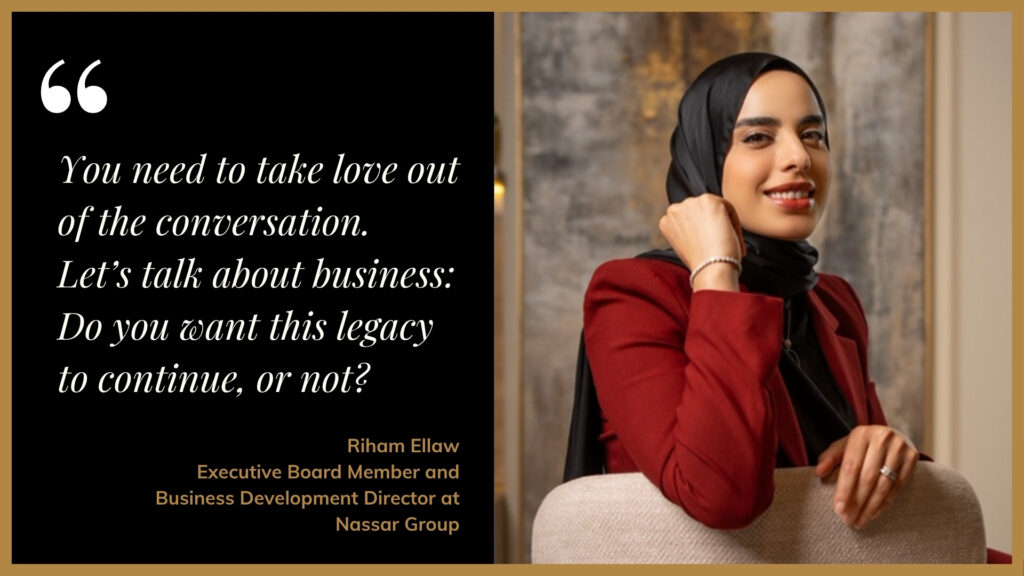
So most people at the same time are struggling with the same issue. So the big family businesses, they understand this problem and they started building. The family governance. Okay. And others they not, they didn’t, and they’re very, very, in the very, very late process. So I have examples and I showed them examples. Okay. Like suddenly, like they, they know a lot of names, so, and I say, where is, uh, this company now? They said, we don’t know. I think something happened to them. I said, no, no, no. I know the history. I know what happened to them. They actually closed because a fight between brothers, actually, this is really happened. And they’re like, really? I said, yeah, I can, I can get for you the, I can show you sources about why, why actually they reached this point. So let’s take love out of the conversation. Let’s take love out of the table. Okay? And let’s talk about business. Do you want this business to continue? Do you want this legacy to continue?
So it’s either continue or not. And for me, it was very, very important for me to continue because I felt that the road that they believe that the business will continue was to get the females out of the picture. I felt that they believe that. Okay, so for me, this was very important. No, to show them no, women or female can be in the picture. And we still can continue. So, you know, they feel like, okay, we are getting like, uh, it’s like, it’s like after, after everyone will enter the business of the second generation. We’ll be 10, 10 in the second generation. And the business is very, very, very huge. So each one will have a role. It’s no problem with that.
But if something happens. Or if a problem happened, let’s take all out the females to make a separate business with the females. So the number of the fights will be less so they will be able to continue. I wanted to show them no, that the problem is not with the females. The problem is everywhere. It’s normal. And actually, this is the problem in Egypt, especially most.
Ramia: It, uh, it very rarely, it very, very rarely is with the women. I would say very rarely that it is with the women the problem, but, okay. Yeah.
Riham: Actually this what happens with a lot of family businesses. Very, very well known names. They just give their daughters name in the board, just name, but they don’t give, give them any executive role. Most of the business in Egypt are this way. Or they give her the idea of the social responsibility of the company. Okay. To, to still take her off the conversation. And I hate that. So I, I always say I’m not gonna be just a name in the board member. If I left the company, I will not be a name in the board member.
So I’m taking responsibility to stay an executive board member, an important board member, for me and my sisters. So I wanna show that the problem is totally different. And the problem is worldwide and very, very well known. So you need to accept it to be able to solve it as long as you live, because it’ll be much, much harder to solve these issues without you. So they understood this and that’s how, how we’re dealing it with now. We’re dealing with it now.
Ramia: So we’re talking about the digital transformation and the need for governance. I think we’re also talking about a very different type of leadership that’s going to be required, right? Like in the future. Not just because it’s, you’re second generation versus first generation. Not just because you know, it’s um, it’s the context, but just because it’s a new economy and we know this, like we are going to see whole industries disappear in the next few years because of the technological advancement and everything like that. So yours isn’t part of it, but it’s changing. The whole industry is changing dramatically. So it’s not just you who changes, but it’s the whole, your whole context and what you operate in, and it just feels like a time where, who we call a leader or who becomes leader needs to have very different skills from maybe the previous generation or what maybe sort of like started businesses in these industries 20, 30, 40 years ago.
So what kind of qualities do you look for now in terms of like leadership and leaders in your company, but also in your family where you think like, okay, with this kind of thinking we’re going to make it, you know, another 20 years, another 30 years?
Riham: This is a very very hard question. This is a very hard business. Okay? And it’s, it’s, it’s large. Okay? And the problem now that you just know what you know within the walls of the factory. So I believe that the one who should lead a family business, who should, he must have like an open view and he must have an experience outside of the borders of the country. It’s, it’s needed because as long as you are within the, the, the four walls, you believe that you are the best, and this is a huge problem. You need to see outside of the box to see that you have a lot of problems. It’s not that easy, okay? Like the easiest thing in, in the products, many products would disappear. So you don’t need to believe now, okay, I’m the largest producer in this, in this area, or I’m the largest producer in Egypt, or are, I’m the largest producer in the world, and you will be able to continue. No, there is a lot of things happening around you that you don’t see, and you just believe that as long as you are stuck in the daily operation, you are the best. It’s not like that. A leader needs to take himself out of the daily operation, and this is a huge struggle with the founders and the second generation because as long as you tell the founder, I shouldn’t be in the daily operation, you just say, okay, you just don’t wanna work. You just wanna, wanna go have a, your vacation. It’s like I shouldn’t know every single step of the day. If I am in, stuck in every single step of the day. No one will be able to develop anything. You will not have a leader. You are actually building new employees. Instead of building leaders, you are building employees.
Ramia: You said before that because you’re the eldest daughter, you watched your father build the business. And I think this is really interesting as a perspective. So when you were a little girl, what did you think you were gonna do when you grew up? Did you think you were gonna do this, or did you have something else in mind for yourself?
Riham: I didn’t know that it would be that hard, but I always have the idea that I would work with my father because I totally love him. And in our culture it was, it’s always, the boy is the one who’s gonna lead the family business. So I knew that he needs a boy. He needs him. That’s okay, but you need him doesn’t mean that your girls are not qualified enough. So he was very, very keen to, to give us the best education, to let us learn new languages, German and all of that, because he’s dealing with this, uh, with these countries. He was very, very keen to build strong daughters. And he was always saying that you are gonna work in the factory. You are gonna work in the factory with me, even though we never went to the factory when we were young and my cousins were going every summer for a training there, and we were not. So you don’t know actually, what does this factory look like? Okay. So for me, I was, I didn’t know it’ll be that hard, I actually wanted to be an artist. But, um, when I was like 14 years old, my first brother came. Okay. And the same time my dad got very, very sick. Okay. He, he got cancer and he was very, very sick. But thanks God. He’s good now. And at this point, this was a turning point for me. I am the eldest sister. If anything happened, I’m the one who’s responsible for all of that. Suddenly. And my brother is very, very, very young and they have a lot of sisters. So it was a huge responsibility for me. Suddenly it was like a shock wake up. Okay? So I knew that this is my road and I have to take it. And I have to be the first daughter and the first woman in such business. And it was very hard because, you know, when I was young, once I was playing with my, with, with a family members and I said that when I grow up, I would go work with my, my father. I’m gonna work with my father. I’m playing and one of the family members called my mom and told her, your daughter is saying that she’s gonna work in the factory.
This factory is only for men. And she was like, they are the owners. They’ll work there. So it actually, the idea was actually forbidden. And the idea, no one understood. No one believed. And I’m always there, people believe that I’m always there temporary from the first day. When I started working, people told me, okay, at the end, you are not gonna continue your husband when you get married. Your husband will not let you continue. When you have kids, you will not be able to continue. It was always the idea when something happened, you will not be able to continue. And it’s not like that. I can do both easily. So this for me was the… It wasn’t easy, but it was the highest motivation for me to show them that I’m here permanent, if I need to be the chairwoman I can.
Ramia: Now that you know so much more about the business, because of course like, you know, you might not have spent your summers there as a kid, but like, because you did the digital transformation and you did the governance, you looked at this business inside out, right? Like you turned every stone and you looked every from A to Z. I’m sure you’re at the level of understanding it as well as the founders by now because you had those difficult conversations. So now that you see its potential and how it works and as you said, it’s already huge. It’s already massive, but do you have a very specific vision in your mind of like, okay, this is, this is what it should look like in, you know, 10, 20 years, but also this is what you would like to do, uh, inside the business or with the business in the future? And, and as a second generation, um, do you have kind of a vision of this now after you’ve accumulated all this information and all this knowledge and also of the industry?
Riham: I have, that I’m very, very sure it’ll be impossible. To, for the second generation to lead the business together, it needs to instead of family business, to be a corporate business, and we need to separate ownership from leadership. It’s a must because the, like I’m talking about 10, will be executive board members. So it’s impossible at the end, someone will have the last word. And we all have to accept that either me or my elder cousin, either anyone the one who is more qualified, but I believe that others will not accept it. Others will not accept that I also should have the last word because I’m also the owner. So I believe, no, we should reach governance at its highest level. There must be external board members. There must be external executives. There must be external CEOs. Everything needs to be external, and the second generation needs to work just as board members. They shouldn’t be involved in the daily operation because the daily operation and the small problems in the day is, is what actually make us reach a lot of problems and a lot of disagreements and a lot of fights. You have no idea how stupid the fights are every day. They’re very, very stupid. So no, we are family members, we are owners. We shouldn’t be involved in such stupid daily operation because at the end, if we are actually dealing with these problems, we are gonna split up. We will split up.
Ramia: I agree with you a hundred percent. We’ve seen so many times that this is a necessary step and it’s a wise step, both also because it helps the family stay harmonious. The relationships in the family can be protected as well from the day-to-day stress of those kinds of things. But it’s still, I think, a matter of like, um, relinquishing control and relinquishing, I guess like an image we had of ourselves as to how we would be working in the family business. Right? Like and, and maybe some of your cousins feel more like, you know, they’ve always imagined them having a very hands-on kind of like, uh, you know, working experience and don’t see themselves as board members.
So, um, what do you think it’s gonna take to get to this vision? Like do you think, are you, are you thinking concrete strategies right now? Are you having conversations like, what is it gonna take to get to that point?
Riham: They still don’t accept the idea that there might be an external board member who will have a voice, they still don’t believe that because at the same problem, as I always say, everyone believes that he understand the business the best. I know the business better than anyone else. I know the business better than any consultant. But I believe that these consultants are actually, so a lot of other companies, so they know your problem. They don’t need to know your product, but they know that they know your problem. So they, we actually started talking about these ideas and they, I believe that sooner or later they have to accept it because sooner or later we are not gonna reach an agreement. So we will need external people to help us.
Ramia: Riham, thank you so much for sharing part of your journey. We can’t wait to see how things progress. We’ll probably have to check in with you in a few years to do another podcast to see how things are going for the Nassar Group and your family. Thank you so much for sharing your journey with Women in Family Business today.