
Interview with Marina Vaughan Spitzy, Founding Director of Telcolote Advisory
From unexpected leadership journeys and role ambiguity to prolonged proving periods, the report uncovers the realities that shape women’s leadership paths. The findings reveal a powerful truth: women’s capability and commitment are rarely in question. What often varies is the clarity of their roles, the transfer of authority, and the readiness of the systems they enter.
In this episode, Ramia and Marina discuss the motivations behind the survey, the surprising insights uncovered, and the transformative potential of recognising women’s agency and power. They share personal anecdotes, compelling statistics, and actionable recommendations for fostering more inclusive and intentional leadership transitions.
Join us as we celebrate the launch of this report and explore how family enterprises can better prepare for and empower women in leadership roles.
To download the full report, click here.
Key Takeaways:
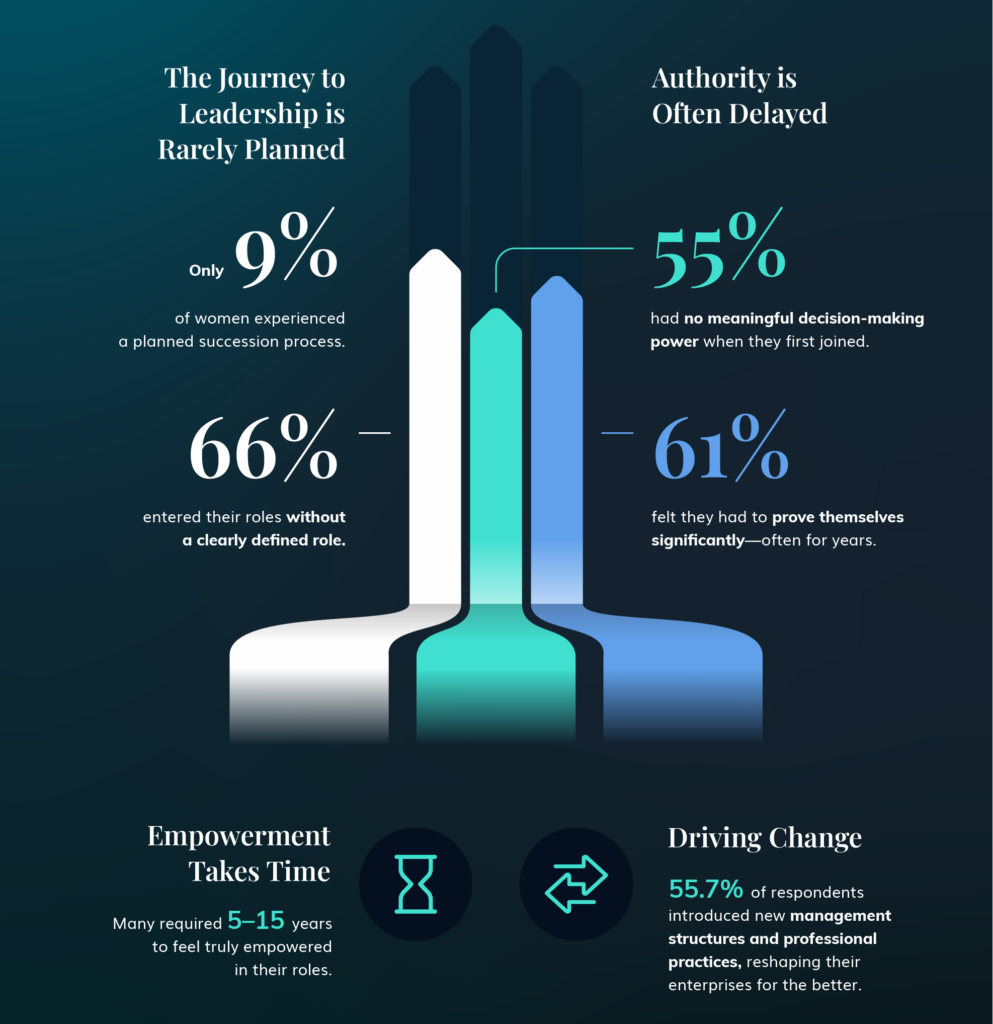
- Unexpected Leadership Paths: Only 17% of respondents knew in advance they would inherit ownership, while 42% had a “sudden entry” into their roles due to unforeseen circumstances. This highlights the critical need for better succession planning and preparation within family enterprises.
- Role Ambiguity and Authority: 66% of women lacked clear role definitions when joining their family enterprises, with 75% defining their roles through “learning on the job” and 45% still figuring it out. This ambiguity leads to prolonged “proving periods” and delayed authority, undermining both individual confidence and systemic effectiveness.
- Transforming Systems for the Future: Many respondents, regardless of their individual outcomes, used their experiences to advocate for clearer roles, governance, and support structures for the next generation. By implementing professionalised frameworks, fostering transparency, and seeking external guidance, they worked to create more inclusive and resilient family enterprise systems.
- Universal Leadership Challenges: The report reveals that many challenges faced by women are not gender-specific but universal to leadership in family enterprises. It underscores the importance of designing systems that attract and retain talent, ensuring all voices—regardless of gender—are heard and valued.
Transcript:
Ramia: Welcome everyone to this special episode of our Women in Family Business podcast. It is special because in this episode we are launching and discussing our new report, women in Power, which describes lived realities of leadership and family enterprises informed by a survey in which more than 106 women from all over the world have participated.
I’m immensely proud today to have as my co-host interviewee, my fellow partner in crime here, my dear friend, Marina Vaughan Spitzy to discuss the results of our very exciting survey that we did over the last year, and, uh, to dive into some of these findings and explain them and contextualize them for everyone a little bit more. And we hope that this leads you to download the full report, read it in full, it’s very exciting. Welcome, Marina, on the podcast.
Marina: Thank you, Ramia, I can’t believe after all this time of talking about putting the survey together, getting it going, the support that we’ve had, and then reading through the responses that now we’re at a stage where it’s all come together and it has shown so much. It’s opened our eyes to so many of the stories, questions that we’ve had about women’s experiences and I’m pretty proud of it.
Ramia: I think pretty proud covers it, like very proud probably comes closer to it we both also know like the challenges we face in putting this together. But, more about, I think maybe it’s worth telling our listeners and viewers here a little bit more about what made you and I and other women feel the need to engage in this particular conversation. We are, for context for listeners who will be listening to this podcast episode further down the line, we are launching this in the context of very soon it being International Women’s Day. And this is when we’re launching the report But I definitely think that we never set out to just create another gender study. Like for us, actually, this conversation is very much about leadership and what leadership should look like in the future in the context of family enterprises. Maybe we can share a little bit, Marina, like what our personal motivations are as to why we even went through this and why we felt the need to create this, this survey, and what it is I think that we felt has not previously been covered enough or in the right way when it came to this particular discussion.
Marina: Well, I think there areour personal experiences and there’s also the, tI’d say professional experience or our, what we did with the last study. So one this, on a very practical level, this survey built on, a study that we did based on 11 interviews with women leading family enterprises. And it came out with some surprising findings.
Five of the 11 women interviewed found themselves in a leadership position completely unexpectedly. For example, and there were after this study findings like that, that left us with questions, such as how common is this? But when we did that study, we didn’t know that we would continue, but there were so oftentimes that we thought, how common is that experience for women?
How common, that that was what brought us together, this shared understanding, even though we come from different family enterprises, different involvements with our families, how often we had shared experiences and. In our conversations with families on a personal and on a professional level, so often there were questions from women saying, you know, does anyone else go through this? Am I crazy? Or, I wish I had known. And so we found ourselves in a position that, should we do more? And the answer was very clearly yes. Because stories of women in, in leadership roles and families are really underdocumented. It’s not that there’s been, no research on female leadership, but there’s room for more and also something that was especially important for me is this recognition of agency, this recognition of power when we called it women with power, because we all have levels of power, we all have choice and agency and this is so often not recognized by the by people wwho have it. And so we wanted to explore these questions, and that turned into this survey. How about for you, Ramia?
Ramia: No, I think like you’re so, I mean, and you and I talked about this, I think we were very critical, critical in, I think we were very critical, you and I, in questioning ourselves as to why we were doing this. Were we doing this out of, I think neither of us wanted to come from a place of resentment or frustration because we didn’t feel, feel that was constructive, and we definitely didn’t just want to create another. What we call women’s report, because we also feel frustrated at times with that kind of thought leadership that kind of, I guess is mostly descriptive of theories around what women’s experiences actually are, and very, very, in very few cases, actually asks women directly and deeply to describe it to themselves and to explain what it was like for them and to allow diversity in those experiences and to allow also to understand what kind of leadership style has emerged from that? Like how did the, how did that shape these women? You know, the challenges and opportunities they face with the family enterprise. How did it shape them into the leaders they are today? I think so when we realize it’s really curiosity to, and, and there’s this sense of like wanting to promote female thought leadership, which as you know, is the mandate also, we have at Women in Family Business always, we saw an opportunity to do this. But I also think the other thing that was very early and very clear, and I think that we need to say here in this podcast as well, when you read that report and when you listen to us talk now, we are really referring to the answers we received in this survey. Because that was what was important to us.
These voices of these women that rarely answer these questions about their journeys and to conclude from their insights what it is that they faced. And so this is not a survey that says these things happen to women and they don’t happen to men. This is not a survey that says like, you know, these are unique challenges that are gender specific in any shape or form.
There’s a few elements where we asked the gender question because you know, it was, there was an opportunity to do so. But most of these conclusions we are very sure that male readers will recognize themselves in a, a lot of the challenges women face and a lot of challenges that are actually probably more telling on how family enterprises function rather than who joins them. And so I think that’s, that’s also really interesting for us that we got to the point where that’s actually what we wanted to illuminate. Not so much what is it like to be a woman in a family enterprise, but rather what kind of leaders does it take and what kind of, what is the definition of leadership that allows a family enterprise to go into the future and to show that it matters how these leaders join and what they experience and how much it allows or hampers their potential. And I think that was our big aim to achieve. And I have to say, the results were very telling and super interesting. And I think let’s dive into maybe some of the highlights here to entice everyone to read our almost 50 page report in, in its entirety. It’ss very graphic guys, so don’t worry. It’s not all texts. So you, you’ll, you’ll get through it. But, maybe let’s tell everyone a little bit about the respondents, like, you know, who responded to the survey. Um, and you actually have a very interesting anecdote as well with regards to why some women that we asked to do this survey did not feel that it was relevant to them, which I always think is like one of the most interesting anecdotes that has emerged from this exercise. So let’s talk a little bit more about who are these 106 women who did us the great honor in answering this survey for us? [00:11:00]
Marina: Yeah, it was really so exciting to see answers coming in from all over the globe, from the US, Canada, Latin America, Southeast Asia, Australia, Asia, Europe, Africa, North Africa, the Middle East. It was extraordinary. The responses were anonymous. But not only did we have a geographic spread, but we had different ages of respondents and also women from different types of family enterprises.
So we had family businesses, we had respondents from family offices, we had women who were, who shared assets in ownership within family structures and beneficiaries of trusts. And so we really had a spectrum of lived experiences with family wealth and responsibility. That was also so interesting that the, that breadth of response also with those women who didn’t feel that they were the right kind of respondents, that they fit our criteria and our criteria was broad.
It was: are you a member of a family enterprise with any kind of responsibility? And time and again, we would get back quips saying, oh, what about women with no power? Or, oh no, I don’t own that. I’m a shareholder. I actually had a conversation with a woman from a family who are, they own just under 50% of quite a large family business, and I was told explicitly, no. My uncle is the boss. We’re just shareholders. It’s not right. We shouldn’t answer this survey because we’re not in a power position. And after I explained that we were still interested in hearing their experience as shareholders, because shareholders have a say in a family business, one of the family members wrote to me saying how she was not only moved, but felt quite angry, with herself and with her family, for not having made that authority more explicit before. And this goes back to what I said at the very beginning of our interview, this agency, it’s not only up to. Us as individuals to grasp it, but it also comes from the system around us to help us realize that we have a responsibility also. So we then with the survey respondents, then we’re able to dig into what those experiences were or their understanding of their responsibility.
Ramia: Exactly, and I think this is maybe also a good, I like good moment clarify for people listening to this, what it is that we actually asked about in stages. Because in our personal experiences, it starts very early. It starts with being born, I guess, into a family enterprise or a family system that owns and operates, whether it’s wealth or an actual business, a company, et cetera. so we really wanted to be honest about what might inform experiences. It’s not just what you face when you are inside the business, but we wanted to start sooner and say like, okay, so from the very beginning. What were expectations before you joined? Why did you then join the family enterprise and how under what circumstances? Once you did join in whatever capacity, whether it’s on the board, whether it’s just becoming a shareholder or whatever, what did you face on the other side of that, basically of that transition? And then how did that sort of like lead to your conclusions later on? Like, so we had like most, most women in this survey, and, and we’ll, we’ll prove that with the statistics here, stayed with their families, but the years that they were there, they did not always have the same level of what they perceived as authority, what they perceived as like recognition and credibility. So we really wanted to document the whole experience until how they felt about it today. Including the women that eventually left and said, this is not for me. I think the entry point, and I think this is a hypothesis that you and I had very early on, right, Marina? Like based on also our, by the, the hundreds of people I’ve interviewed, the hundreds of women you’ve interacted with in your career is that how you the family business, family office experience really matters. It really matters to what extent you’ve been prepared, to what extent you’ve had the expectation all your life. I’m gonna start with one of the more staggering statistics that we’ve discovered here, and that is that only around 17% of our respondents knew in advance that they would inherit ownership.
Marina: Mm-hmm. And then, it was 9% of our respondents, despite that breadth of respondents had a planned entry?
Ramia: 42% had what we called a sudden entry, meaning that circumstances dictated and 44% had a gradual entry, informality across the board was the norm. Most of these women had an extremely informal entry into the business. Yeah.
Marina: yeah, and that’s, and that shows that the challenges that come with the role, if you’re not planning it, if it’s not prepared, I mean the gradual, the 44% who had a gradual entrance. Some degree more of preparation and learning on the job, but it shows automatically from just the first stage of how these women entered their roles, that the systems were not prepared to receive them.
It’s not even a question on whether the women were prepared or not. It shows that the system was not prepared to receive the successor.
Ramia: Admittedly wasn’t, it wasn’t prepared to absorb whoever was going to come in. And I think motivation matters because we’ve come up with this sort of like combination slash equation of it is that makes women take on often very unattractive roles because often when you are asked suddenly to enter into a role or like, you know, the circumstances can be less than, positive, right? Like, can be less than supportive. And so, when we asked women why they joined, there was 17% who basically all submitted not having known that they would, that only 17% knew that they always would and that they would inherit ownership and that they would be, you know, required to eventually assume a role, but a staggering 49.15, so almost half, their main motivation was to support their family. So it came from a sense of duty, of support. It’s very relational. And, a same amount approximately of respondents also felt they could make a meaningful contribution. So these were not like shy or uncertain about what they could do for the family.
Many of them came in feeling like, you know what, actually I’m the right person to do this right now. And so, you know, I, I’ll come in and, and help out. And one third stepped in due to a sudden need. And so you see that, you know, the circumstances around family enterprises really, or like how family enterprises work as systems, show you that, you know, that support plus contribution, plus circumstance that shapes the journey of our respondents, really shows that there is absolutely never a linear path that can, that can draw a, a realistic picture of what succession and even planned succession looks like for these families and for these, for our respondents.
And so that’s been really interesting. Maybe one thing that we can do here, like just a few of the quotes, um, in relation to why they, why they joined. Like some people saying to us, they needed me so I came, I was overlooked for years until suddenly I wasn’t. And then another respondent who said it was supposed to be temporary, then it wasn’t. So it’s interesting, right? Like to see also like how, again, how we enter really informs what the experience afterwards looks like. And as you said, the nature of entry, that one’s been really interesting. And I think here, this, this talk about informality, why informality has sort of like been the nature of even the planned succession that we’ve seen here, uh, maybe deserves a bit of elaboration.
Marina: I would go on from there to talk about the role ambiguity. You know, you were talking about this relational quality of why women were joining because they wanted to help their families, or there was a need, but there’s a knock on effect of coming into a role often through an unplanned path or unexpectedly, but also with little clarity around the role. It has effects on the position. And so when that position is undefined, it lowers your confidence because you’re starting off questioning, what should I be doing? What is expected of me? What is needed right now, and what am I allowed to do? Not only that, that delays the authority. When you don’t know what you’re supposed to be doing, it’s very difficult to be able to assert yourself, and that’s not just bad on the individual, it’s bad for the system because it makes others around you question if you have the authority. It undermines your legitimacy, is what I’m trying to say. So there’s this prolonged proving period because you’re coming in feeling around not just for what you’re supposed to do, but if you even have a right to do it. And so that proving period is deeply damaging, and we had time and again from respondents, this proving period when we asked how long until you had authority, five years, what came up a lot. But we had eight years. We had 15. We had one woman say never, I left. Of course, some women were able to establish authority and then it went really well. Bu the point is when there’s little role clarity and no authority, it makes that path into authority or into leadership much, much more challenging.
And I’d like to also give another quote that I have that one woman wrote. I was competent, I was prepared, but I still felt like I had to earn a right that others were given automatically.
Ramia: And this is like, to be very clear, it’s just the statistical probability that it would go that way was just extremely high for all respondents. Like it looked like, you know, you talked about role ambiguity, 66% of our respondents did not have their role clearly defined when they joined the family enterprise. When we asked them, how did you define the role over time? 75% said, well, it was just learning on the job. 45% said, said that they’re still figuring it out. And, and so this also binds into sort of like the proving period that you were talking about where how long should it take someone to be able to step into their authority, their legitimacy, when they join the family enterprise? So there’s, you and I have discussed this a lot, like where we understand fully that is in fact a proving period that is quite normal in any role, isn’t there? Like, you know, even if you join any job, if you join any organization, there’s a time of adjustment. But I think we also came to the conclusion that, well, especially in a senior role, if that time of adjustment takes more than a year, something is wrong. And I think this is also like one of our first indicators as to why we are actually, um, really talking about a conclusion that leads us to look more at the system rather than at what these women are lacking because a definition of a role, that should be if maximum a joint effort. But essentially the system should be ready with clear expectations towards the person joining and allowing them to make it a success by knowing what they’re walking into. And again, I think we both come from family enterprise backgrounds. We understand the necessity and the advantages of certain types of informality in how we run a family enterprise – allows us agility, quick decision making, and all of these things. But I think what we’ve seen here is that informality is used a little bit as a coverup to just cover up inherent biases. You know, sort of like unpreparedness, lack of diligence, that then has a huge effect on the people assuming these roles, and I think also the fact that only half of the respondents actually felt that they had decision making power as they joined the family enterprise. Even though many of these people joined as shareholders or as actual executives or like, who were actually put in, in positions where they had to take decisions. My God, they were taken on board for that. The fact that they’re only, not even, not even 50% actually felt that they had that power was extremely telling. And we very much, as you said, like the proving period, also showed that it was almost an impossible fight for many of our respondents to, to get to a point where they felt they could overcome this informality. And so I think, I think this quote that you mentioned was, was very, very interesting because it came back to proving, I think one of the biggest correlations we’ve dared to actually extract from this, because again, correlations are very tricky.
We know this, uh, especially on a small sample, but at the same time, there were just certain trends that we could not ignore, and that is how much the survey showed us that early experiences and how we enter really shapes the later realities for the respondents. There’s a very, there’s a very clear correlation, between role clarity and decision making power and the proving period as you’ve mentioned. But let’s also talk Marina about like, you know how, because a lot of these women stayed and like, you know made incredible successes of this. This is definitely not a victim’s narrative. Like this is not like a sad narrative. Most of these women, I would say have, have done incredibly well, have changed, have changed their family enterprises to a great extent. So let’s talk a little bit more about what it is that we’ve seen in terms of like how they manage to find their place become effective, but also what it is that they fundamentally changed and addressed in their family enterprises.
Marina: One of the most interesting, uh, findings about what they changed is the women were. They changed from what they had had from experience. They wanted more clarity for the next generation. They went in and said, that was not the best way to handle things. I’m going to make it better for the next generation. So they have led from this memory of what was missing, not from this assumption of what was sufficient. And I think that is really, really telling. And they have built this credibility, not with using shortcuts, but with improving the system so that the system is better prepared to support the next generation of leaders. They have found peers, mentors, outside advisors, they champion other women. And they are more willing to ask for help for themselves too, and find what it is that they need to succeed by building their system and by getting the support from outside.
Ramia: And I think this is, like two quotes here that we have also in the report, which really reflect that feeling. I became more ambitious as I saw what was possible. At first I wanted to fit in. Now I want to transform. That’s probably one of my favorites. This kind of like comes full circle as to like, why we did this, why we did this survey in the first place. The really honest conversations about what it is like, it all often feels like we don’t wanna talk about it. It can feel like come from family enterprises, we know this. It can feel like a betrayal of the family if we don’t, if we don’t sort of like gloss over some of the bits that are, that are challenging, but really how helpful it is, I think for people everywhere to realize how common these challenges are. How if you just ask a hundred people, you will emerge with such clear trends. And these were very people from very di diverse backgrounds culturally and, and, uh, even in size of business. And to find so many shared traits was incredibly telling and interesting.
And also for us, kind of like formulated an ask that we have after this survey because we didn’t just wanna it out there. There’s a huge gap in, in talking about women’s leadership journeys and, and documenting them. So that’s one element of the survey. But the other one I think is to emerge a very clear, crystallize a very clear ask to the family enterprise as a system. Because the message we got here from our respondents is, as you said, Marina, they were ready. The system wasn’t, And however subjective that perception is, again, over this sample that was, that was largely the feeling that was conveyed. And so I think it would be interesting maybe to talk a little bit about our conclusions that we drew from this in terms of like what we thought emerged as a message maybe also between the lines, what it is that family enterprises now should be doing and thinking of in order to avoid people having the most difficult journey possible. It’ll always be challenging. Family enterprises are by nature, not exactly the easiest environments to work in, depending on, on, on how you were raised and what, what kind of dynamics you’re dealing with. But we, I think we both agreed after a while. Well, it doesn’t have to be this hard, It could definitely be designed. Better. And again, these are not gender specific needs that we’re seeing here. These are needs that any leader will face in trying to become effective in a family enterprise. So, talking a little bit about what we felt, and this is not, as we say in the report, we’re not asking for radical reinvention for family enterprises. We’re asking for just, paying attention to the right areas that really need improvement if you want to attract and retain the right talent from your family. I dunno, if you wanted to say a little bit more about what it is that you’d expect from the systems and like what you’d like family enterprises to take up from this report?
Marina: I think it’s not wrong to want to support your family. It’s not wrong to step up and to step in, especially when you love people. You have an emotional connection, but it’s also fair to ask for a clear role because it doesn’t just help establish your understanding, protecting you and helping you to give back to your family. But it protects the roles and relationships between siblings, between different branches, between those stepping into roles from a family and employees. So clear roles and expectations. It’s right to be able to ask for constructive feedback, for example. And this all comes from transparency about expectations. On a more developed role, one can have professionalized governance. Professionalized doesn’t mean that you need to have a family charter or constitution. We don’t even go into that in the report, but it’s about having really discussed roles and expectations in the family and, that can be in whether they’re pathways into leadership, into understanding how communication works at a family level and at a shared asset or at a responsibility level. It’s about knowing what’s expected at different ages and at different times. And when in doubt, get an outside person to come in and tell you you’re not crazy or to share their experiences, whether that’s from peers, whether it’s coaching, if it’s getting a mediator to come in and help you navigate family tensions. Um, I don’t know. Have, which ones have I missed? They’re not gender specific, are they? They’re really human needs.
Ramia: They’re not at all gende specific, but I think this is also what shows us, right? But this is also like part of the adjustment of our thinking. Just because something as women in the title or has the word power in the title, it does not mean that, you know, the gender agenda is the only element here. What we’re essentially saying, like, you know, we are documenting underrepresented content and thought leadership and experiences in order to get a fuller picture of how the family enterprise actually works. And I think this is something that we have to be very honest about. If not everybody’s story is told… If not everybody’s experience counts, you will never get a fully comprehensive understanding of what actually makes or doesn’t make your family enterprise function and work. If you ignore people’s sacrifices, but ignore people’s mistakes equally, because whatever the reason, because they were not the intended error or because there was like, you know, we are informal so we don’t document these things, I think you’re in real danger of missing an opportunity for massive exponential learning for your family enterprise system and for making sure that also in future you’ll be able to, to look back at a history, at a shared history that you agree on, because how could it possibly be that people have such diverging experiences in the family enterprise and then be able to carry on forward? Because at some point, I think, you know, you come to very decisive moments as a family office or a family business, and then understanding shared history and having the communication that you talked about is the essential underpinning to moving things forward and making, you know, good leadership decisions for, for the whole, for the whole organization or system.
And so for us, this is really like an appeal to everyone to read this report, whether you feel addressed or not. We stand by the choice of name because we think it’s like a celebration of, and a thank you to, the respondents because we see their power, even if sometimes they don’t see it themselves, and we acknowledge their agency even if they struggle at times themselves. But we see what they’ve done and we see what they’ve achieved. And, and we wanted, we wanted to give a, a celebratory nod to the fact that in fact, you are a woman in power if you’ve answered this survey. And there are many of them out there. And we hope that this also encourages you, that, you know, you’re not alone in your experience, but that this also gives you the, I guess like the groundwork to go to your family and say, guys, we have work to do. We can do better and, and quite easily. So.
Marina: The women are ready now. How can the systems get even better at preparing for them and supporting them?
Ramia: Yeah, we simply need the systems to meet us halfway. Marina, such a joy to do this work with you, to talk to you as always. Absolutely fantastic. I can’t wait to see what kind of conversations come from this? Um, we are obviously reachable for anyone who wants to continue this conversation and talk to us more in depth about this.
Thank you for coming on the show.